Meta Description: OpenAI launches GPT-5.3-Codex in response to Claude Opus 4.6. We compare architectures, SWE-Bench and Terminal Bench results, and explore how this new agentic AI model outperforms its competitors in autonomous coding and development.
Abstract: The release of GPT-5.3-Codex by OpenAI, hot on the heels of Anthropic's Claude Opus 4.6 announcement, marks a new chapter in the race for agentic AI. This review provides a detailed analysis of the new model's architecture, its focus on autonomous programming, and its enhanced capabilities for terminal operations.
GPT 5.3 Codex is OpenAI's latest model, specifically engineered for programming, agentic automation, and autonomous code execution. Its release came almost immediately after Anthropic unveiled Claude Opus 4.6, intensifying the competitive landscape of the AI market.
This new iteration of the GPT-5 family represents a significant leap forward, not just in processing speed. The model achieves state-of-the-art results on key benchmarks, demonstrating proficiency in interacting with terminals, integrated development environments (IDEs), and version control systems. Crucially, it can autonomously manage complex development tasks.
This review explores what sets GPT-5.3-Codex apart from its predecessors, analyzes its performance on benchmarks like SWE-Bench and Terminal Bench, discusses key takeaways from AIBC Eurasia 2026, and examines the role of the new Frontier platform.
OpenAI positions GPT-5.3-Codex as the evolution of the GPT-5 and Codex lineages, purpose-built for real-world software development lifecycles. Unlike earlier versions primarily used for generating code snippets via API or ChatGPT, this model can now execute entire chains of tasks autonomously.
GPT-5.3 Codex is OpenAI's first model designed to act as an autonomous agent in the development process. Its capabilities include:
The model offers improved inference speed compared to its predecessor and delivers more consistent results when tackling challenging development tasks.
The true measure of GPT-5.3-Codex's capability lies in its benchmark performance, showing a notable improvement over previous GPT-5 versions.
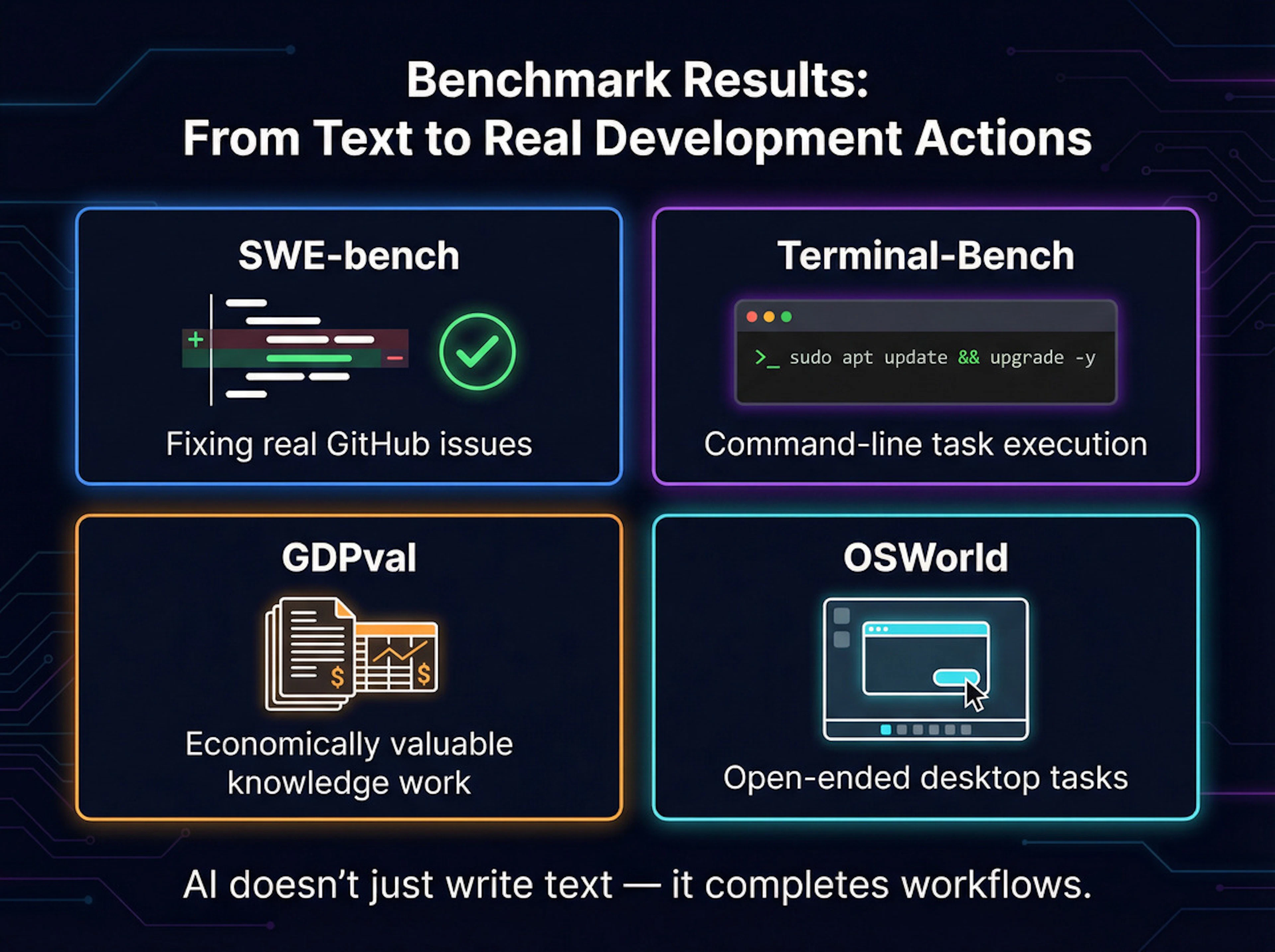
This progress underscores a fundamental shift: AI is no longer just a text generator but an active participant in the development process.
A central theme at AIBC Eurasia 2026 was the integration of AI agents into IT and business operations. The conference's key takeaway was the market's definitive shift from experimental demos to tangible, real-world deployment.
Industry experts highlighted that models like GPT-5.3-Codex perfectly embody the trend towards autonomy. Enterprises are moving beyond viewing AI as an experimental tool; it is becoming an integral component of their production systems.
Key discussions revolved around data security, governance policies, scalability, and managing deployment with AI oversight. These are precisely the areas where OpenAI is focusing its development efforts.
A significant development accompanying the model is the OpenAI Frontier platform. This infrastructure solution is tailored for the enterprise segment.
Frontier provides companies with the tools to:
With Frontier, OpenAI is betting on more than just the model; it's providing systemic, enterprise-ready solutions. This is crucial for large organizations where security and governance are non-negotiable.
Anthropic's Claude Opus 4.6 entered the arena with a massive 1-million-token context window, strengthening its position in tasks involving lengthy document analysis.
However, GPT-5.3-Codex differentiates itself by focusing on execution and action. In the specific domains of coding and agentic workflows, it achieves more stable and higher scores on benchmarks like SWE-Bench and Terminal Bench.
The strategic difference is clear: while Claude Opus emphasizes context, GPT-5.3-Codex prioritizes the process. It is architected to autonomously drive complex projects, analyze problems, and implement solutions with minimal user intervention. As competition between OpenAI, Anthropic, and Google intensifies, the agentic model has become the primary battlefield.
For developers, GPT-5.3-Codex translates to:
For companies, it offers a path to optimize the entire software development lifecycle, reduce operational costs, and improve final software quality.
The model is accessible via a robust API, integrates seamlessly with popular IDEs and web-based tools, and can assist in building projects with a high degree of autonomy.
GPT 5.3 Codex is more than just an incremental update; it represents a significant stride toward fully capable AI agents that can execute complex tasks autonomously.
With this release, OpenAI strengthens its market position by offering not only a powerful model but also the Frontier infrastructure to support secure, scalable enterprise adoption.
Strong performance on SWE-Bench, Terminal Bench, GDPVal, and OSWorld confirms that the model is faster, more stable, and more effective than its predecessors. In the near future, agentic systems like GPT-5.3-Codex will likely play a pivotal role in transforming software development, data analysis, and IT management. For professionals and organizations looking to stay ahead, integrating and mastering these tools is becoming essential.

Max Godymchyk
Entrepreneur, marketer, author of articles on artificial intelligence, art and design. Customizes businesses and makes people fall in love with modern technologies.